
Spotlight on Katseye
A Netflix documentary details the creation of the "global girl group" while shining a spotlight on the strength of female friendships and the cruelty of the entertainment industry

As promised in my news wrap up, I have now watched Pop Star Academy: Katseye on Netflix, and I found it very thought provoking.
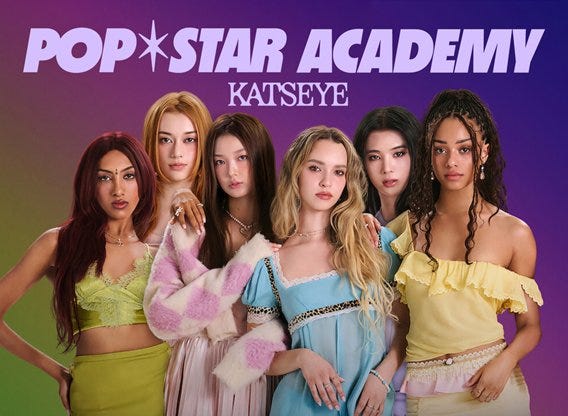
Takeaway #1: Attitude matters
There are a lot of differences between the Kpop industry and the “Western” pop industry, and there are a lot of differences between a Kpop idol and a pop star. Project manager Missy noted early on that one thing that makes pop stars interesting to global audiences is “edge,” which is something that is not particularly valued or encouraged in the Kpop industry.
But one thing that became clear over the course of the documentary is that attitude and commitment matter everywhere. A recurring storyline was future Katseye member Manon’s perceived lack of commitment to the group due to frequently missing rehearsals and breaking house rules. Here Missy noted that humility and kindness are valued very highly in Kpop stars, but star quality sometimes comes with arrogance. That being said, it became clear that in order to make a successful team, egos had to be broken down and edges smoothed in order for the group to fit together.
Given the importance of a good attitude and good team chemistry in both Kpop and global pop (who can ever forget the way Fifth Harmony imploded), I did find it surprising that the show focused so heavily on tension between Manon and the other girls. I did not think Manon came across very well for the majority of the documentary, and her “redemption arc” prior to making the band was not long enough for me as a viewer to be convinced that things were actually resolved.
A final note on attitude - I also thought there was a really interesting moment when Son Sungdeuk, the creative director of the project and BTS’ choreographer, cancelled rehearsals for the day after feeling that the girls were disrespecting the art and technicality of Kpop by performing in an overly cutesy manner. I thought this was a fascinating example of the thin line between appreciation and fetishization of Kpop.
Takeaway #2: Survival shows are cruel
After over a year of training and development, the show surprised the girls by suddenly becoming a survival show to determine the final lineup. This was obviously a strategy to build buzz and a following for the group, but was a dramatic shift from evaluations reflecting the opinions of the girls’ teachers and label executives to more of a popularity contest that quickly became dominated by nationalism and those with an established social media following.
On this point, the girls made some very compelling critiques themselves, frequently complaining that they were never told this would be a survival show and highlighting how it changed the tone to became a social media popularity contest. Contestant Karlee when she was eliminated said, “From the start, we didn’t know this was a survival show. It was supposed to be training, pick the girls, prepare for debut, and debut. What embodies Kpop in a group is their bond and their trust in each other, and what survival shows do is put contestants against each other. I don’t believe in putting people against each other to form a group.”
The most cruel moment came at the end of the second evaluation when it was revealed that the girls had been asked privately to create their own dream groups of 6 and the results of that “voting” were made public, revealing those girls with very few votes. The horror on the girls’ faces as this was revealing was truly disomforting, compounded by the subsequent elimination of girls by a robotic AI voice as literal wails filled the room. It was pretty horrific to watch, and then label executive Mitra seemed completely unapologetic. She was like yeah I understand why the girls were upset but it got our highest ratings…shrug.
The cruelty and popularity of these survival shows is obvious in Kpop as well, with a memorable example being Felix’s unnecessary elimination from Stray Kids during their survival show. Can we really stomach watching these groups be formed at the cost of these young people’s mental health? Is it really worth it?
Takeaway #3: Is the project going to be a success?
I love the idea of applying the Kpop methodology to a global girl group but will it actually work? Very famous and successful British girl bands (Little Mix, Girls Aloud) have tried and failed to break into the American and global market. American girl groups have been relatively few and far between. In an age of confessional pop starlets is there broad appetite for the type of surface level generic pop music generated by the Kpop industry? I don’t think this training and development approach could ever produce a Chappell Roan. As a barometer, one could look at Katy Perry and Camila Cabello’s recent unsuccessful comeback attempts as indicators that pop music consumers are looking for authenticity rather than generic “recession pop.”
But if that is the case, then how can you explain the global success of Kpop? Perhaps here we go straight back to attitude - humility, kindness, openness, and commitment to the craft are attitudes well received by fans and may be an acceptable alternative for some to the authenticity of confessional song lyrics. And the truly successful Kpop groups must be both excellent in all things (image, dance, music) and appealing and accessible to fans. There are a LOT of Kpop groups that do not succeed.
So did this project and this documentary do enough to set up the Katseye girls for success? Well a few weeks ago I saw an anonymous tip on DeuxMoi that execs are horrified by the poor sales performance of Katseye. Obviously, I’m not sure if that’s true and in fact I do feel that Touch has been fairly ubiquitous this summer although it definitely did not reach the heights of Magnetic. I did enjoy watching the documentary but I’m not sure it made me feel “closer” to the final lineup, especially as I have mixed feelings about the way everything went down. I could talk about this forever but I think I will end there!
Sound off with your thoughts in the comments, and if you want to read more on this topic, I recommend Bunni Pop’s article (and her interview with Katseye!!):

It was really fascinating to watch for me. Interestingly, I love the final lineup of KATSEYE and think all the members add something different to the group, and they complement each other so well! However, I couldn't help but feel for the girls in the docuseries who didn't make it. Having watched The Dream Academy there was no indication of any of the contestants' backstories and that really bothered me. It's a ruthless way to do a survival show. I can only hope the contestants find success in other ways!