
Let's talk about GFriend
GFriend are reuniting for their 10 year reunion - it's the perfect time to review their story and investigate why they were disbanded!

GFriend is a fabeled girl group in Kpop circles but the unitiated may not be familiar with their strange story. Given news of their reunion next year, it’s a perfect time to learn a little bit more about them.
To tell the story of GFriend we must first tell the story of their label, Source Music. Source Music was founded in 2009 by So Sung-jin, who was a talent manager at SM and also did a stint at JYP. At some point, he got involved in managing the solo career of Kan Mi-youn, a very popular member of the successful first gen girl group Baby V.O.X., who was then being managed by the company H2 Entertainment. As is not uncommon in the industry, he decided to start his own company and immediately signed the artist he was managing. This was Source Music and Kan Mi-youn was his first sign. She released a successful single in 2010.
Another up and coming label was started in the 2000s by an alum of JYP Entertainment. I’m talking about Bit Hit Entertainment, started by Bang Si-hyuk in 2005. It seems likely Hitman Bang and So Sung-jin had developed a good working relationship while overlapping at JYP, because in 2012, they embarked on a joint venture to promote a new girl group named Glam, with Source managing and Big Hit producing. The group stopped activity in 2014 after low levels of success and high levels of messiness, and disbanded in 2015. In the meantime, Big Hit had debuted a boy group that you may have heard of - BTS.
With the disbandment of Glam, there was an open spot in Source Music’s roster for a girl group, so in January 2015, the label debuted a new six member group called GFriend with a song called Glass Bead. This was a golden period of third generation girl groups - Red Velvet had debuted in 2014, Twice also debuted in 2015, and Blackpink was soon to debut in 2016. Despite the competition, GFriend found a surprisingly high level of success. Part of their appeal was that they were a girl group very much in the style of Girl’s Generation, in contrast to the more popular girl crush concepts of other 3rd and 4th generation girl groups.

Let’s take a quick interruption to introduce you to the members of GFriend. Born in 1995, the leader Sowon provided main vocals, visuals and HEIGHT. She left DSP Media to join Source Music, where she trained for a year and a half before debuting. Yerin trained at Fantagio and Cube before joining Source Music, and she was the center of GFriend. Eunha trained at Big Hit for 1 year before joining Source and training for 2 months prior to GFriend’s debut. Main vocalist Yuju trained at LOEN, and main dancer SinB trained at both Big Hit and LOEN before joining Source Music. Maknae Umji was born in 1998 and was street-cast by the CEO of Source Music and trained for 1 year before debuting in GFriend.
Back to the story! While promoting their super cute second single Me Gustas Tu in 2015, a fancam of a live performance went viral. This catapulted GFriend to a new level of fame, and they won 15 music shows with their next comeback Rough. Once they achieved this level of success, they really maintained this level of success through 2018, winning 32 more music show trophies and achieving another chart topper with Navillera and number two singles with Fingertip, Love Whisper, and Time for the Moon Night.
I (of course) applied the methodology I’ve used in the past to analyze Itzy, Enhypen, and ATEEZ, and what I found definitely surprised me. Despite having the earliest debut in the calendar year relative to these other groups, GFriend definitely had the weakest debut year. This is perhaps to be expected from a group debuting from such a small agency. However, in every subsequent year, GFriend showed strong growth in their numbers, and by their fourth year they were experiencing success at the level of JYP’s flagship fourth gen girl group Itzy. This level of success raises questions for a group from an established big four agency like JYP, but for a group from a small agency like Source, it’s astounding!
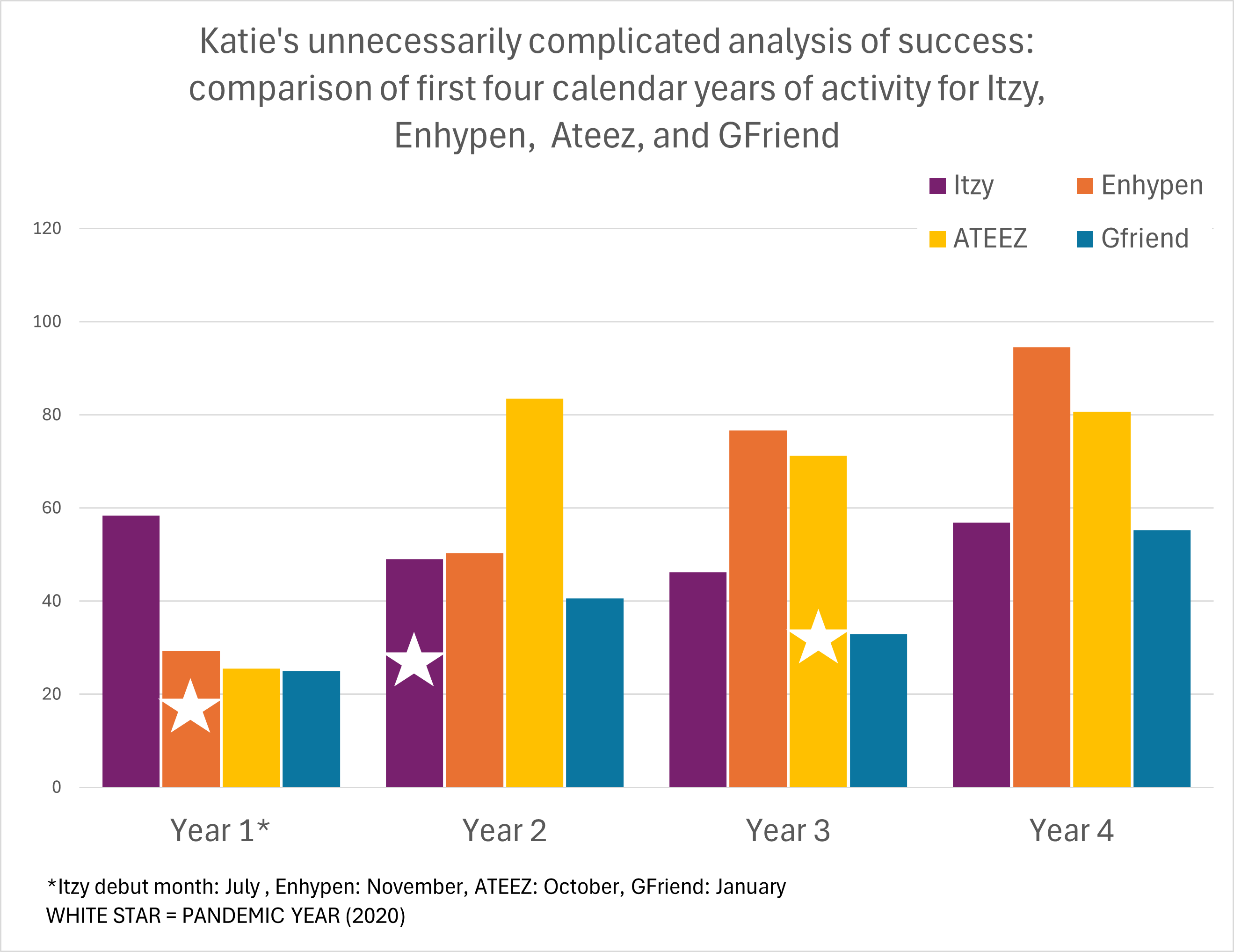
Further, the factors driving GFriend’s success are much different than the other three groups I’ve looked at previously. Sales for GFriend’s albums are very low relatively speaking. This may be in part because they are from an older generation than the other groups and album sales were not in trend at all during their early days. They also didn’t embark on extensive international tours. Instead, their success is driven by very, very strong comebacks that charted incredibly well in Korea and won lots of music shows. In their career, Enhypen have won 15 music show awards. GFriend won 15 music awards with Rough alone.
So what happened after their fourth year of activity? In January 2019, GFriend released Sunrise (which did well but not AMAZING) and began a Japanese tour alongside Japanese singles and album releases. And then in July, big news! Source Music was acquired by their old collaborator Big Hit Entertainment and would become a subsidiary under what would become HYBE. This deal was presented as mutually beneficial - Big Hit acquired talented trainee pool and a proven history of developing a successful girl group, and Source Music would be able to access Big Hit’s formula for creating global superstars. At the time, Hitman Bang said the two agencies shared a similar philosophy in nurturing and managing artists and that the two agencies knew each other well. This was Big Hit’s first acquisition (Enhypen’s label Belift Lab is a collaboration between Big Hit and CJ ENM)!
In the midst of all of this, GFriend released Fever Season, their seventh Korean EP. The lead single Fever won 6 music shows but was their lowest charting comeback ever at 27! This EP also marked the first time the production team 13 worked on GFriend tracks. They didn’t work on the title track, but they did work on the lead single off of their debut Japanese studio album from the same year - Flower. Can you feel the difference?
In February 2020, GFriend released their Labyrinth EP with lead single Crossroads. This album was the first album with collaborations from their new labelmates at Big Hit - Hitman Bang and other Big Hit producers like Adora provided overall direction and direct contributions. The lead single, however, was still written by GFriend’s usual collaborators (at least since Time for the Moon Night) No Joo-hwan and Lee Won-jong. By July, these two had been pushed out, and the next comeback, Apple, was by Hitman Bang and PDOGG. This was a dramatic departure for GFriend as they experimented with the girl crush concept for the first time. It was also probably GFriend’s least successful comeback ever, with only 3 music show wins and a chart result at 54. That being said, the accompanying album was their best-ever selling EP, selling over 90,000 copies.
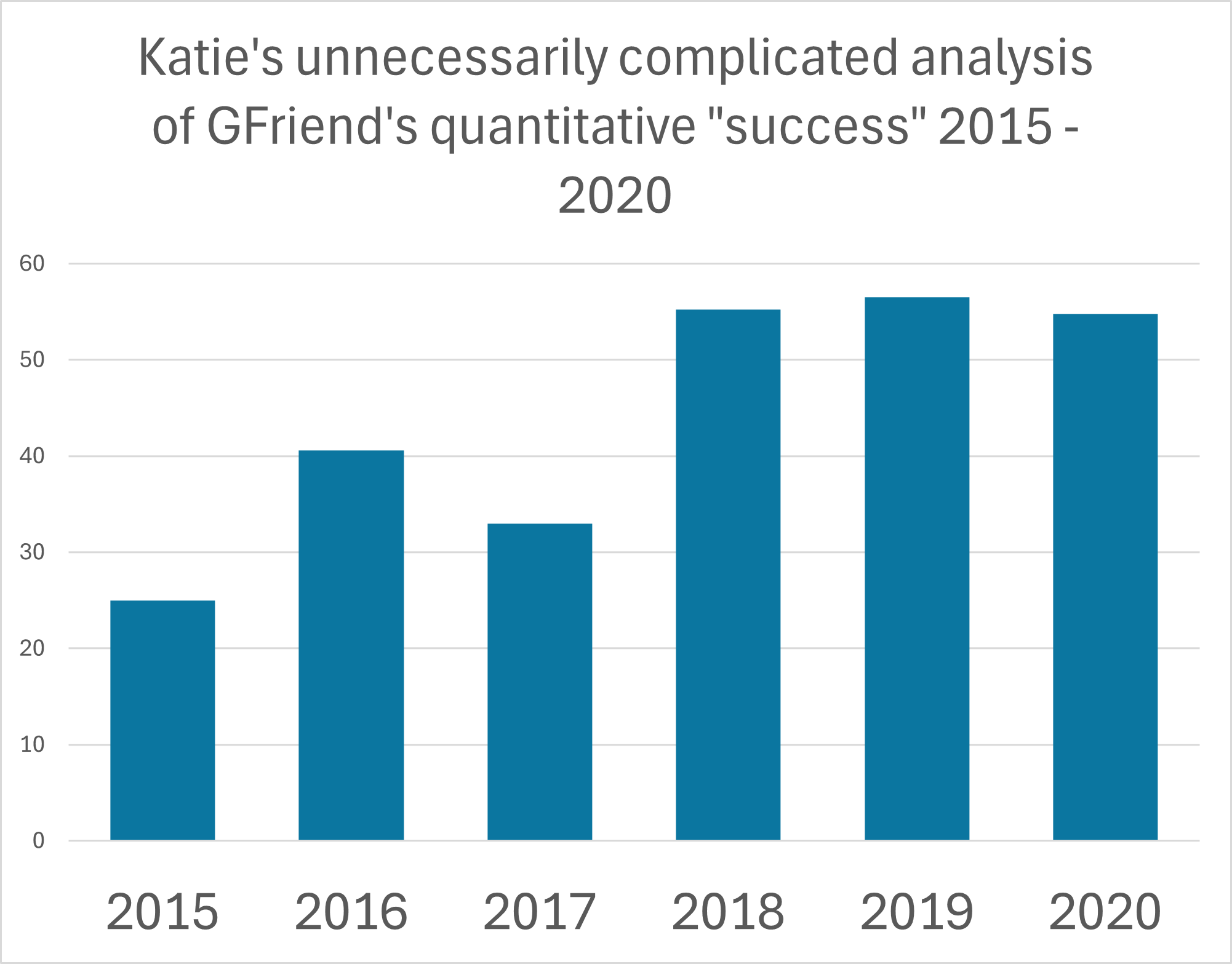
When we look at the analysis of GFriend’s success from 2015-2020 we can definitely see a plateau after 2018, but by no means a decline in success! They were just a bit stagnant. So then what happened? In November 2020, GFriend released their third Korean studio album, Walpurgis Night, with lead single Mago, once again produced by in house Big Hit producers (this time Hitman Bang and FRANTS). Once again, the comeback did not do particularly well - although let me say it still charted better than any Enhypen song has yet to chart in Korea! And if you look at the most recent three years of activity for all the groups I have looked at, you can see that even at this point in their career, GFriend were performing consistently better than Itzy have the last three years, and JYP is still actively promoting Itzy.
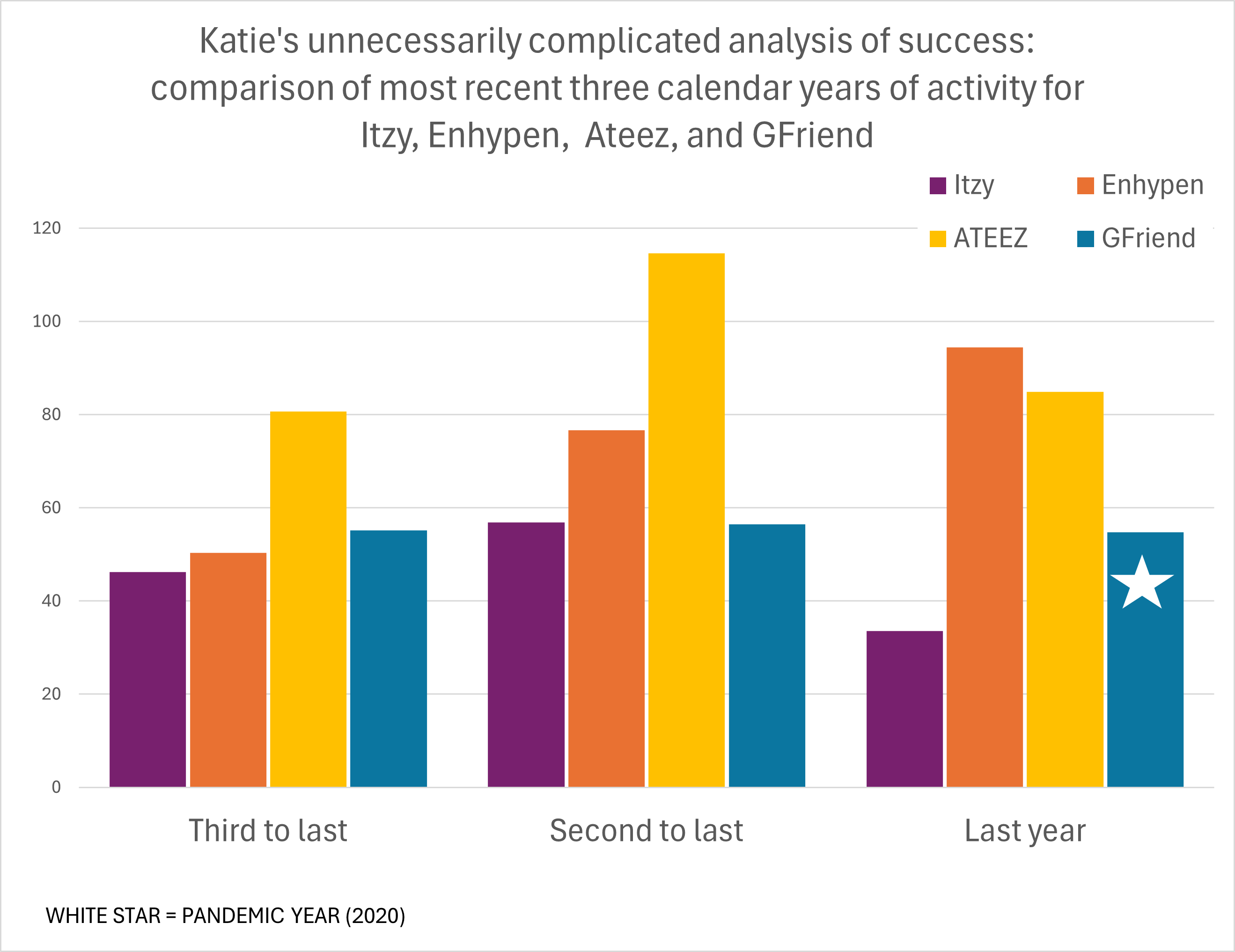
Therefore it was a bit inexplicable when, in May 2021 it was announced that all six members had decided to leave Source Music upon completion of their contracts and GFriend disbanded 3 days later. If you’re doing the math in your head, yes, the usual Kpop contract is 7 years, so yes, this smells fishy! What happened? Well from my analysis here I think there are three possible explanations:
GFriend didn’t fit the vision Big Hit had for their global girl group, the female version of BTS. They were too old, the concept was too cute, and Big Hit’s attempts to modify their sound on their last two EPs hadn’t really succeeded. So yes, what I’m saying in this case is that Big Hit acquired a successful girl group from a small agency, and instead of improving on what made the group successful, they tried to completely change the formula and then disbanded the group when it didn’t work to make room on the roster for the next girl group from Source Music - LE SSERAFIM. This feels like a really harsh take!
Some members of GFriend wanted out. You can see this from what they have pursued subsequent to disbandment. Sowon has unsuccessfully pursued acting, joinning and then leaving two different entertainment agencies and acting in only one made for tv movie. Yerin has pursued a solo music career. Her third album just came out three weeks ago, with lead single Wavy. She has also had several tv show hosting gigs. Yuju was also active as a soloist for a few years following disbandment and she has also worked as a radio DJ and gotten more involved in songwriting.
But even if Sowon wanted out and Yerin and Yuju wanted to go solo, Eunha, SinB, and Umji all wanted to stay as a group - they all signed with BPM Entertainment and formed a group called VIVIZ. VIVIZ has done well, releasing four top ten albums and achieving great success with last year’s super popular Maniac. Unclear why Source Music didn’t hold on to at least these three!GFriend got caught in the crossfire between Source Music and ADOR. Let me explain:
Remember from my notes on the training history of the GFriend members, the Source Music team have a proven history of recruiting talented girls. Their strong trainee roster was part of why HYBE was excited to acquire Source Music, remember? So who were these talented trainees? At the time of the merger in 2019, there seem to have been at least three trainees we might recognize - Kim Minji, who joined Source Music in 2017, and Hanni and Noh Yunah, who both joined in 2019 (Yunah left in 2021 to join Belift Lab, where she would later become a member of ILLIT). Over the course of 2020, several other notable trainees were recruited - Kang Haerin, Danielle, and Kim Garam. In 2021, Hyein, Kazuha, and Eunchae all joined Source Music.
This brings us to Min Hee-Jin, who was brought on by Big Hit in 2019 to launch a new girl group - presumably under Source Music. However, in the end, of course, she decided to launch the group under her own new label. She started ADOR and handpicked 5 Source Music trainees to bring with her - Hanni, Minji, Haerin, Hyein, and Danielle.
I would assume the negotiations for the establishment of ADOR and removal of 5 Source trainees from the pool of possible Source Music girl group members took some time. The label was eventually started in November 2021. I would guess that with the writing on the wall that Source Music would be losing 5 promising trainees to this new Min Hee-Jin girl group, they took some action to boost their trainee pool. In April 2021, the girl group Iz*One disbanded and two members subsequently signed with Source Music - Chaewon in June and Sakura in September. These two, alongside Kim Garam, Eunchae, Kazuha, and Huh Yunjin, would debut as LE SSERAFIM.
The decision to start a new label, recruit two established stars, and launch two new girl groups within months of each other feels…expensive. Perhaps something had to be cut to afford all of this and the decision was made to disband GFriend - even the three remaining members who wanted to continue as a group - in May of 2021 - not going to lie, the timing lines up!
What also lines up is the fact that all six girls are coming back to Source Music in January 2025 for a tenth anniversary celebration. Perhaps now, after the girls have explored solo careers and acting and other ventures and Source Music has made a bunch of money with LE SSERAFIM, Source Music can give GFriend some of the attention and celebration they deserve.